

Ustensile de chef
Stainless Steel Bowls 1.5L to 4.5L – Sturdy & Versatile Kitchen
Stainless Steel Bowls 1.5L to 4.5L – Sturdy & Versatile Kitchen
Free delivery in mainland France. Processing within 24 to 72 business hours, followed by estimated delivery within 7 to 15 business days after shipping. Tracking sent by email.
Couldn't load pickup availability
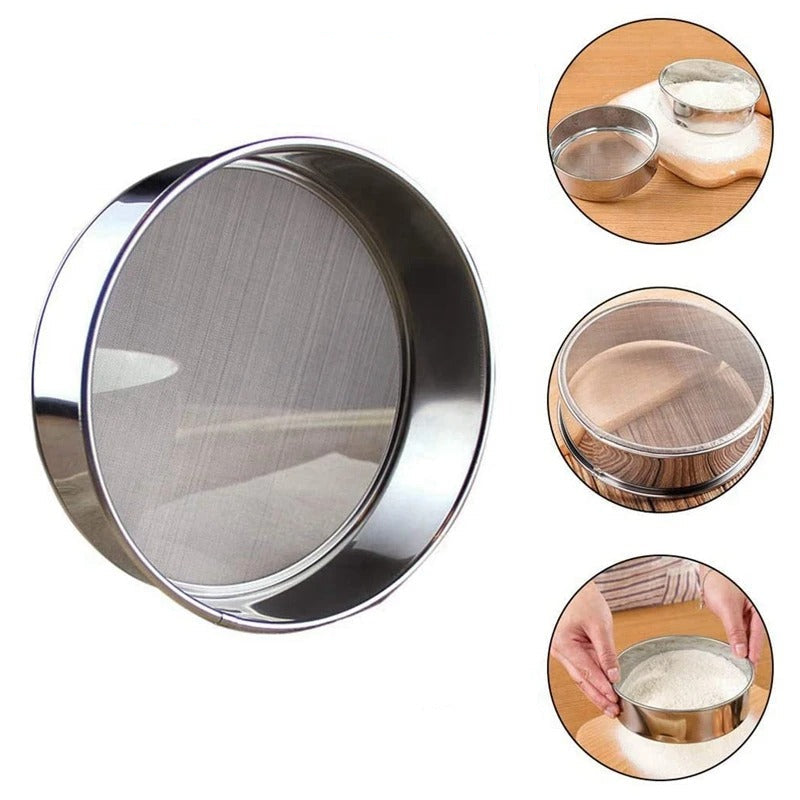
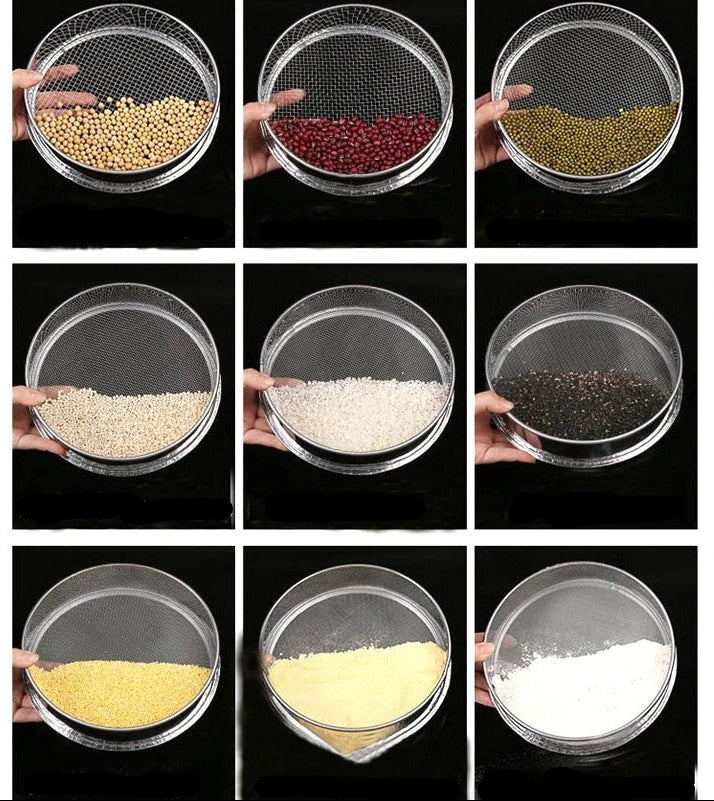
Very fine flour, coarser almond flour, or a mixture containing small pieces do not necessarily require the same sieve. With this stainless steel pastry sieve, you choose the fineness of the mesh based on what you want to let through or retain, rather than always using a single mesh size.
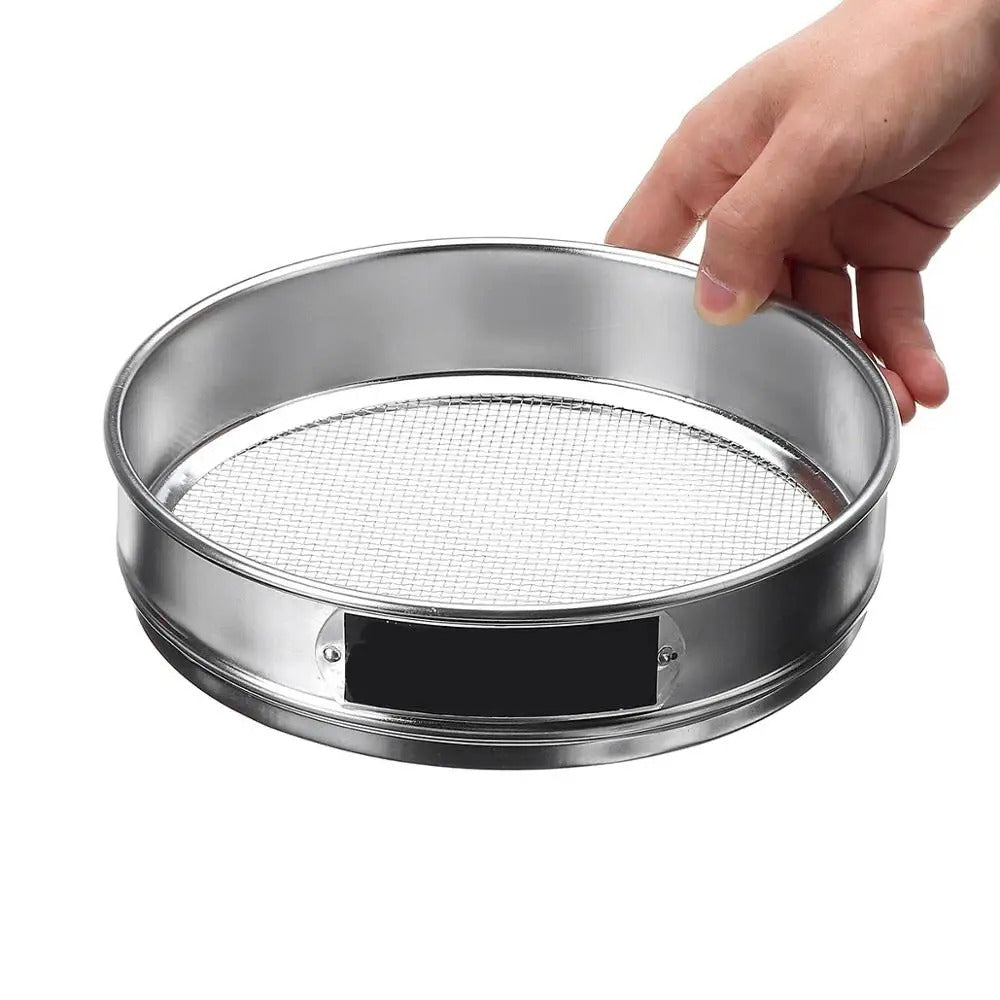
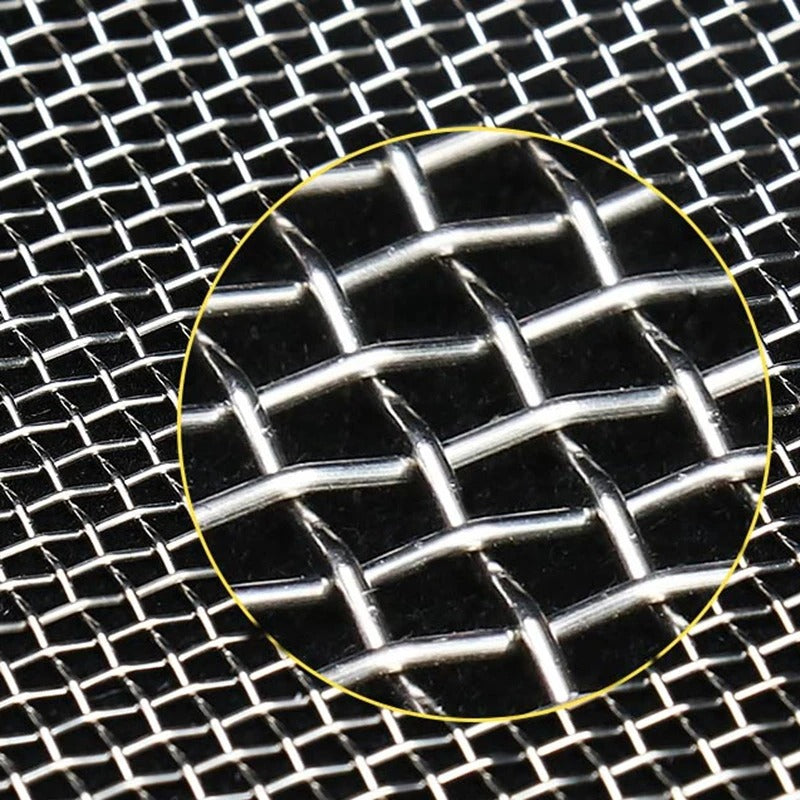
Available in three diameters of 15, 20, and 25 cm and in eleven mesh levels from 10 to 120 mesh, this round sieve adapts to different cooking and baking tasks: sorting dry ingredients, removing oversized particles, or obtaining a more homogeneous powder before incorporating it into a recipe.
A distinct variant including a base and a lid is also offered in each of the three diameters. It allows you to complete a compatible sieve without having to choose a new mesh fineness.
The right mesh for each preparation: choose the diameter and fineness of your sieve based on the ingredients you are working with, without multiplying utensils with poorly identified characteristics.
Why choose this stainless steel pastry sieve?
The particularity of this model is to allow a precise choice among eleven mesh levels. This diversity becomes particularly useful when you are preparing different recipes or want to separate particles of various sizes.
- Eleven fineness levels: from 10 to 120 mesh to choose a tighter or looser mesh.
- Three diameters: 15, 20, or 25 cm to adapt the working surface to your quantities.
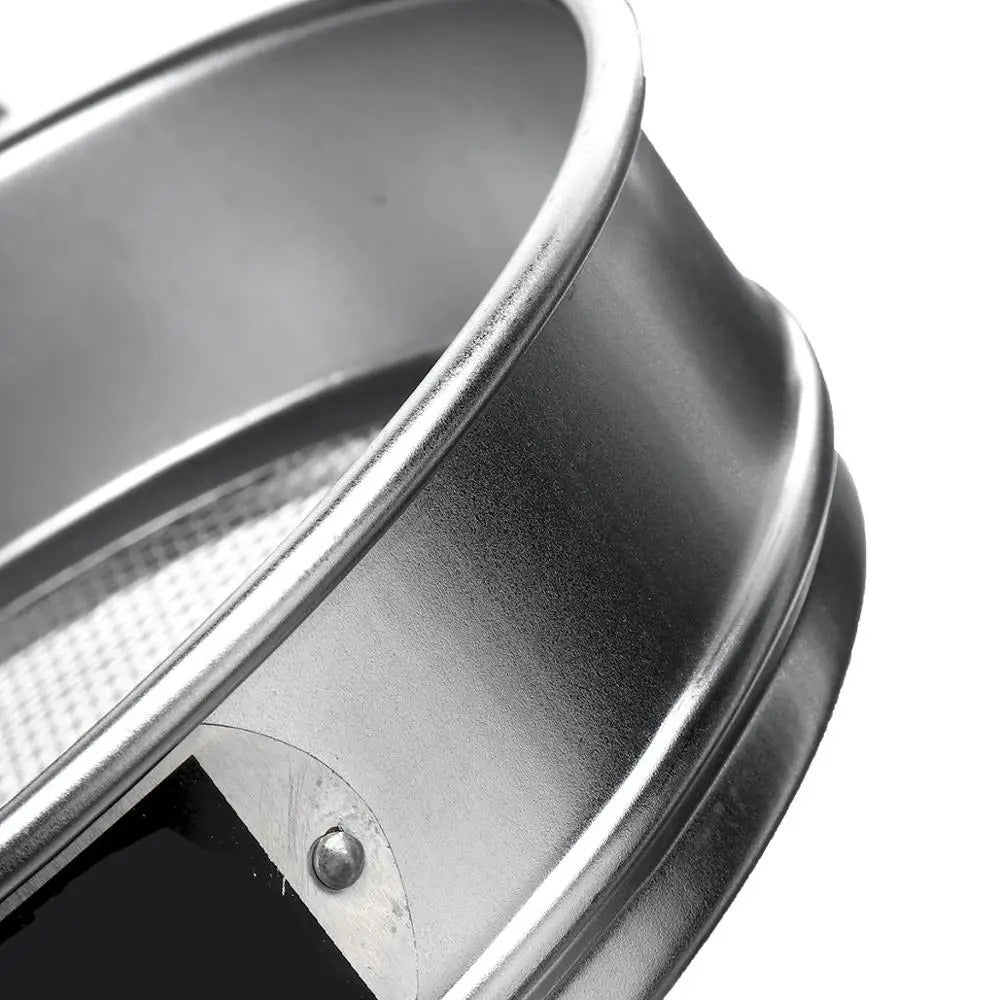
- Stainless steel structure: a metal sieve designed for repeated sifting and separation operations.
- Round shape: practical for distributing ingredients over the entire surface of the mesh.
- Accessories available separately: a base + lid variant exists for each diameter.
This sieve is therefore not chosen solely because it is made of stainless steel. Its interest lies mainly in the possibility of selecting a mesh adapted to the ingredient and the desired result.
Technical characteristics of the stainless steel sieve
| Characteristic | Detail |
|---|---|
| Product type | Round kitchen and pastry sieve |
| Advertised material | 304 stainless steel |
| Available diameters | 15, 20, and 25 cm |
| Available meshes | 10, 12, 20, 30, 50, 60, 70, 80, 90, 100, and 120 mesh |
| Number of sieve combinations | 33: 11 meshes for each of the 3 diameters |
| Complementary variant | Base + lid, available in 15, 20, and 25 cm |
| Total number of possibilities | 36 variants, accessories included |
| Main use | Sifting and separating particles according to the fineness of the mesh |
| Recommended maintenance | Manual cleaning, rinsing, and complete drying |
Important: each sieve corresponds to a selected diameter and mesh. The eleven meshes are not supplied together. The base + lid variant is a distinct choice and does not automatically include a sieve.
How to choose the right mesh: from 10 to 120 mesh?
The mesh number refers to the number of openings per linear inch in a mesh. With a comparable design, the higher this number, the smaller the openings.
A 10 mesh sieve therefore lets through larger particles than a 120 mesh sieve. However, the mesh number is not enough to determine the exact size of the openings in millimeters: this also depends on the diameter of the metal wires.
| Mesh | Fineness level | Intended use |
|---|---|---|
| 10 mesh | Very coarse | Separate large pieces or solid elements from a mixture |
| 12 mesh | Very coarse | Perform an initial sorting of relatively large particles |
| 20 mesh | Coarse | Remove the largest pieces from a dry ingredient |
| 30 mesh | Intermediate | Refine an initial sifting of powders or granular mixtures |
| 50 mesh | Fine | Work with dry ingredients requiring finer separation |
| 60 mesh | Fine | Retain smaller particles than with a coarse mesh |
| 70 mesh | Fine | Refine the sorting of powders with different particle sizes |
| 80 mesh | Very fine | Achieve tighter sifting of sufficiently dry powders |
| 90 mesh | Very fine | Limit the passage of fine particles in a mixture |
| 100 mesh | Very fine | Perform fine separation on a small quantity of powder |
| 120 mesh | Finest in the range | Retain more particles, with potentially slower passage |
These examples illustrate the relative fineness of the meshes. They do not guarantee a result for a particular ingredient. The behavior of the preparation depends notably on the particle size, their moisture, and the quantity poured.
Which sieve to choose for flour, cocoa, or almond flour?
For flour: separate lumps from the powder
Classic wheat flour consists of relatively fine particles, but it can form clumps during storage. For simply removing lumps, an extremely tight mesh is not always necessary.
If you are looking for more selective sifting, you must consider the actual particle size of your flour. A mesh that is too fine can considerably slow down the passage and retain part of the flour you want to keep.
In the case of whole wheat flours, the mesh can also retain bran. This changes the composition of the flour used in the recipe: do not remove these elements without considering the desired result.
For cocoa: prepare a more uniform powder
Cocoa powder can have small clumps. A sufficiently fine sieve allows you to retain them before mixing the cocoa with the flour or other dry ingredients.
For a chocolate preparation, you can start by sifting a small quantity to check that the powder passes correctly through the chosen mesh. If it remains blocked while dry, a looser mesh may be preferable.
For almond flour: select the particle size
Almond flour sometimes contains larger fragments than others. With a suitable sieve, you can separate fine particles from coarser pieces.
This operation is useful when preparing recipes sensitive to texture, especially certain biscuits or macaron shells. However, no single mesh guarantees a result suitable for all almond flours: their fineness varies depending on the grinding.
To avoid wasting ingredients, start with a small quantity and observe what passes through the mesh before sifting the entire preparation.
Which diameter to choose: 15, 20, or 25 cm?
The diameter influences the surface available for distributing the ingredients. With the same mesh, a wider sieve allows you to work on a larger surface, but requires more space for storage and handling.
| Diameter | Recommended use | Main advantage |
|---|---|---|
| 15 cm | Small quantities, mesh testing, occasional preparations | Compact format and easy to handle |
| 20 cm | Common pastry preparations, intermediate portions | Compromise between surface and bulkiness |
| 25 cm | Larger quantities, repeated sifting of dry ingredients | More generous working surface |
Our advice: if you want a versatile sieve for your usual preparations, the 20 cm diameter is an interesting starting point. The 15 cm is better suited to small quantities, while the 25 cm is relevant if you regularly sift larger volumes.
However, the quantity of material that can be worked in a single pass depends on the height of the sieve, the fineness of the mesh, and the fluidity of the ingredients. The diameter alone does not allow you to define a precise capacity.
Base and lid: what is this variant used for?
A variant composed of a base and a lid is offered for each of the 15, 20, and 25 cm diameters.
It allows you to complete the corresponding sieve, notably to limit splashes during certain manipulations and collect the ingredients according to the configuration of the set.
For example, when working with a very fine powder, the lid can help contain the particles that disperse during sifting movements. The base can serve as a collection support when its assembly with the sieve allows it.
Pay attention to the choice of variant: the base and lid are offered separately from the sieve variants. Select the same diameter as your sieve. This option does not replace a mesh and does not have a mesh value.
How to use a fine-mesh stainless steel sieve?
- Choose the diameter: adapt it to the quantity of ingredients and the space available on your worktop.
- Select the mesh: start by determining whether you want to remove large pieces or perform a finer separation.
- Prepare a clean container: place it under the sieve to collect the particles that pass through the mesh.
- Pour a small quantity: distribute the ingredients without forming a layer that is too thick.
- Perform gentle movements: shake the sieve lightly to facilitate passage.
- Examine the residue: check the retained particles before continuing with the rest of the preparation.
For very fine powders, it is better to multiply small portions rather than fill the sieve. This limits blockages and maintains better control over the result.
Can this sieve be used to filter liquids?
The metal mesh can also retain certain solid particles present in a liquid. The result depends on the selected mesh and the consistency of the preparation.
A coarse mesh can quickly let through a liquid while retaining relatively large pieces. A very fine mesh can retain more particles, but it also risks clogging faster, especially with a thick preparation.
For a cooled coulis or an infusion containing residue, test a small quantity before processing the entire preparation. This sieve guarantees neither the complete clarification of a liquid nor the filtration of particles of a determined size without precise data on the openings.
It also does not replace a colander designed for large quantities of pasta or vegetables.
Why is a very fine mesh not always the best choice?
It may seem logical to systematically select the highest mesh number. However, a tighter mesh is only useful if it corresponds to the desired separation.
With a 120 mesh, particles that would pass through a coarser mesh may remain retained. This is interesting for very fine sorting, but it can become inconvenient if you want to retain the entire powder.
Conversely, a 10 or 12 mesh allows you to separate larger elements, but it does not fulfill the same role as a very fine sieve for small-particle powders.
The right choice is therefore not the finest mesh, but the one that lets through what you want to keep and retains what you want to discard.
What difference is there with a wooden-handled sieve?
A tstainless steel kitchen friend with a wooden handle is suitable for common pastry tasks, such as sifting flour, preparing cocoa, or dusting a dessert.
This round sieve meets a different need: explicitly selecting a mesh level among eleven possibilities. It is particularly relevant when you want to compare several separation finenesses or work with a chosen particle size.
For the filtration of cooled liquid preparations, you can also consult our fine PP and nylon sieve, offered in 100, 200, and 400 mesh.
These three products do not differ by a quality hierarchy. Each corresponds to a different way of working the ingredients and choosing the filtration fineness.
How to maintain stainless steel meshes after sifting?
After using the sieve with flour or another dry powder, first remove the residue by light tapping. Avoid rubbing the mesh hard with a metal object, at the risk of deforming the wires.
If particles remain stuck, clean the mesh with warm water using a soft sponge and a suitable dish soap. A thorough rinse helps remove residue that could dry in the openings.
Dry the sieve completely before storing it. Residual moisture can promote the clumping of powders during the next use.
As dishwasher use is not confirmed for all variants, favor manual cleaning.
What accessories to pair with this pastry sieve?
To work cleanly, provide a container wide enough under the sieve. Our stainless steel bowls with non-slip lids can notably receive the sifted ingredients before their incorporation into a dough.
If you are making pastry preparations that subsequently require precise plating, you can complete your equipment with the accessories from our Piping Bags and Nozzles collection. Sifting then takes place at the time of preparing the ingredients, while the nozzles are used to work the final presentation.
Discover our selection for sifting, filtering, and preparing
Find this product in our Colanders, Sieves, and Spinners collection, which brings together different utensils according to the nature of the ingredients and the desired operation.
To compose equipment adapted to your way of cooking, also discover our main collection of kitchen utensils.
Our guides to understanding sifting
The choice of a mesh makes more sense when you understand what sifting really changes in a preparation.
- How to avoid lumps with a whisk?: a method for preparing your dry ingredients.
-
Why sifting flour improves pastries?: the effects of sifting on the distribution of powders and the mixture.
- How to sift flour correctly
In stock / Delivery / Warranty
- In stock – limited quantity
- Automatic order tracking by email
- Simple returns within 14 days ( see conditions )
- 100% secure payment
- Responsive customer service 7 days a week
FAQ: choosing and using a stainless steel baking sieve
Which mesh size should I choose for sifting flour?
There is no single mesh size suitable for all flours. To remove simple lumps, a relatively open mesh may be sufficient. To separate finer particles, a tighter screen will be necessary. The choice depends on the particle size of the flour and the amount you want to let through.
What is the difference between 60 mesh and 120 mesh?
With a comparable design, a 120 mesh screen has smaller openings than a 60 mesh screen. It can therefore retain more fine particles, but sifting may be slower. The mesh number alone does not allow you to calculate the exact size of the openings.
Is a 100 mesh sieve suitable for almond flour?
It can be used to perform a fine sorting, but a large part of the almond flour may remain retained if its particles are too large. For macarons, first test a small quantity to check that the result matches your recipe.
Can I use this sieve for powdered sugar?
Yes, provided you choose a mesh that lets powdered sugar through without excessive clogging. To simply remove lumps, the finest screen is not necessarily required.
What sieve diameter should I choose for baking cakes?
The 20 cm constitutes an intermediate choice for common preparations. The 15 cm is suitable for small quantities and the 25 cm for larger volumes. However, the diameter does not determine the fineness of the sifting: this depends on the selected mesh.
What does 10 mesh mean on a stainless steel sieve?
The 10 mesh value indicates a relatively coarse mesh, containing about ten openings per linear inch. It is used to distinguish this screen from finer meshes. The actual size of the openings also depends on the thickness of the wires.
Are the base and lid provided with each sieve?
No. The base and lid constitute a distinct variant, offered in the diameters 15, 20 and 25 cm. They are not automatically included when you select a sieve with a mesh value.
Can I buy only the base and the lid?
Yes. Simply choose the base + lid variant in the desired diameter. Check that this dimension corresponds to that of your sieve.
Can a fine mesh sieve replace a pasta colander?
This is not the most practical choice. A pasta colander is designed to quickly drain a large quantity of water. A fine sieve prioritizes the separation of particles and can greatly slow down the flow.
Why does my powder not pass through a 120 mesh sieve?
The particles may be too large for the openings of the screen or form clumps due to moisture. A less fine mesh may be more suitable. Avoid pressing hard on the screen to force passage.
How to avoid clogging a very fine sieve?
Work with ingredients as dry as possible, distribute them in small quantities and clean the screen after use. A damp or clumped powder can obstruct the openings and slow down sifting.
Is this sieve suitable for professional use?
Its range of meshes allows you to choose different levels of separation, which may interest users looking for precise sifting. However, no certification or particular metrological performance is guaranteed by the available information. For use requiring a certified dimensional tolerance, you must have complementary technical specifications.
Choose the sieve suitable for your preparation
To remove large pieces, prepare a more uniform powder or perform a finer separation, start by identifying the desired result. Then choose the mesh and diameter corresponding to your way of working.
Select your variant from the eleven meshes and three diameters available, or choose the base and lid suitable for your sieve.
The right utensils make the right cooks.
Partager
parfait
très bonne qualité et expédition rapide
Parfait ! correspond exactement à mes attentes. robuste et se bonne taille. je recommande !
Un autre tamis filtrant pour le miel
Bien, correspond aux filtres :)